Almost everyone starts with one or two Pylontech batteries, adds a third the following winter, and a fourth when the electric car arrives. How far can you go? Do you need special equipment beyond a certain number? Can you mix a 2021 US2000C with a brand-new US5000? And above all, which cables do you need at each step? This guide answers all of these questions, with a ready-to-order cable list for the size of your bank.
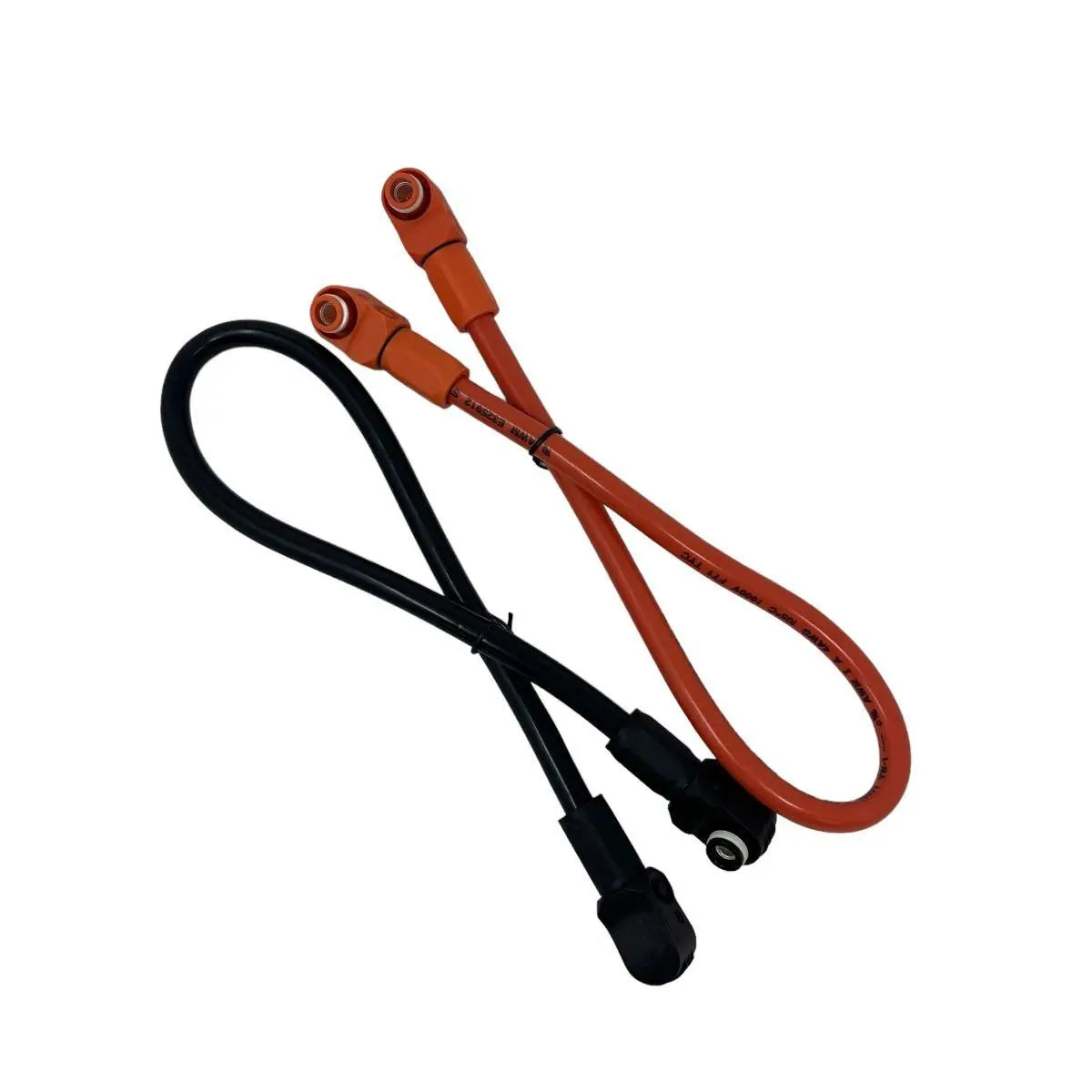
Pylontech allows up to 16 modules in parallel in one group (US2000C, US3000C, US5000), linked by a single LINK bus and a single master battery. Beyond that, or to spread the bank over several racks, you move to several groups connected through an LV-HUB (up to 6 groups). For N batteries in a group, you need N−1 pairs of parallel cables, N−1 RJ45 LINK cables, 1 RJ45 cable to the inverter and a pair of main cables sized for the total current.
The official limits
A low-voltage Pylontech US battery is a 48 V nominal module. You increase capacity by adding modules in parallel: the voltage stays the same, while capacity and available current add up.
| Configuration | Number of modules | What you need |
|---|---|---|
| Single module | 1 | Cables to the inverter + RJ45 inverter cable |
| One group (one master battery) | 2 to 16 | Parallel cables + LINK chain + 1 inverter cable |
| Several groups | More than 16, or several separate racks | An LV-HUB that centralises each group's communication towards the inverter |
These figures are the BMS communication limits. In practice, the real limit is often elsewhere: the inverter's maximum current, the section of the main cables, the space in the rack and the budget. A bank of 4 to 6 modules covers the vast majority of homes with a 5 to 10 kW hybrid inverter.
How many batteries for your needs?
The question is not only "how many are possible" but "how many are useful". A few benchmarks:
- Evening self-consumption (lighting, appliances, router, a few hours of TV): 5 to 10 kWh usable is often enough, that is 2 US5000 or 2 to 3 US3000C.
- Shifting a heat pump or water heater to the night: 10 to 15 kWh, around 3 US5000.
- Charging an electric car from the battery: capacity grows quickly, and the inverter current becomes the limit before the number of modules does.
Think about current too: each module added increases the charge and discharge current the bank can accept. With a single module, the battery sometimes limits the inverter's power; with several, the inverter becomes the limit.
Can you mix models and ages?
This is the question we hear most often when someone expands an existing bank. The answer: yes, under conditions.
- Models: Pylontech accepts certain mixes within the US range (US2000C, US3000C, US5000), but with rules about the BMS firmware version and which module must be master. Check Pylontech's compatibility note for your exact combination before buying.
- Firmware: modules bought years apart do not run the same BMS version. Some differences are harmless; others trigger alarms or communication faults. Pylon-Monitor has published a detailed guide on mixed BMS firmware versions.
- State of charge at connection: before connecting a new module to a bank in service, bring both to a similar state of charge (ideally all fully charged). Connecting a module at 100 % to a bank at 20 % causes a large balancing current between them at the moment of connection.
- Wear: a new module next to five-year-old modules works, but some bank limits follow the weakest module. That is normal and safe, just worth knowing.
Write down the model and serial number of each module and, if possible, the BMS firmware version (visible through the CONSOLE port or a monitoring device). This information will save you a lot of back-and-forth with your installer or with Pylontech.
The cable list by number of batteries
Here is exactly what you need for one group, assuming you keep the supplied cables where they fit.
| Batteries | Pairs of parallel cables | RJ45 LINK cables (battery-to-battery) | RJ45 inverter cable |
|---|---|---|---|
| 2 | 1 | 1 | 1 |
| 3 | 2 | 2 | 1 |
| 4 | 3 | 3 | 1 |
| 6 | 5 | 5 | 1 |
| 8 | 7 | 7 | 1 |
The length depends on the layout:
- Tightly stacked modules: 48 cm parallel cables.
- Modules spaced for ventilation: 70 cm.
- Side by side, or two racks: 1 m or 2 m.
- Special configuration: our custom cable configurator.
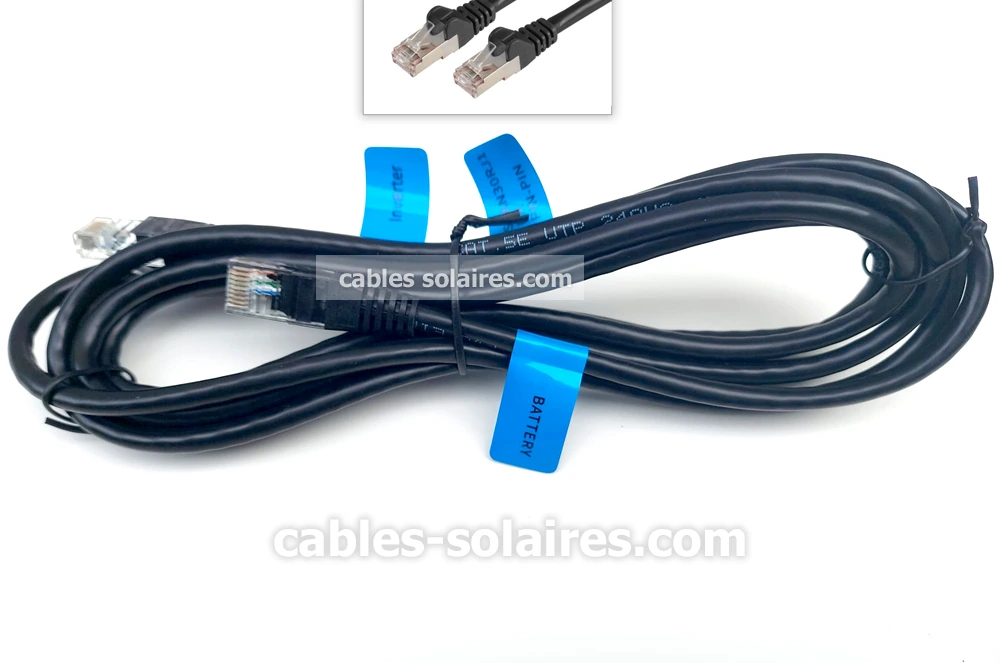
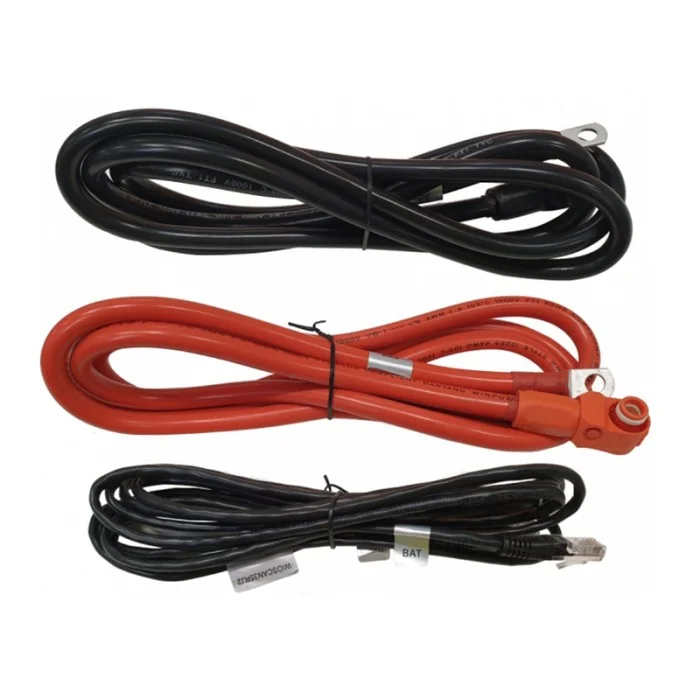
For communication: one battery-to-battery RJ45 cable per link, and a single battery-to-inverter RJ45 cable from the master battery. The ports are explained in our guide Pylontech RJ45 cable: battery-to-battery or battery-to-inverter.
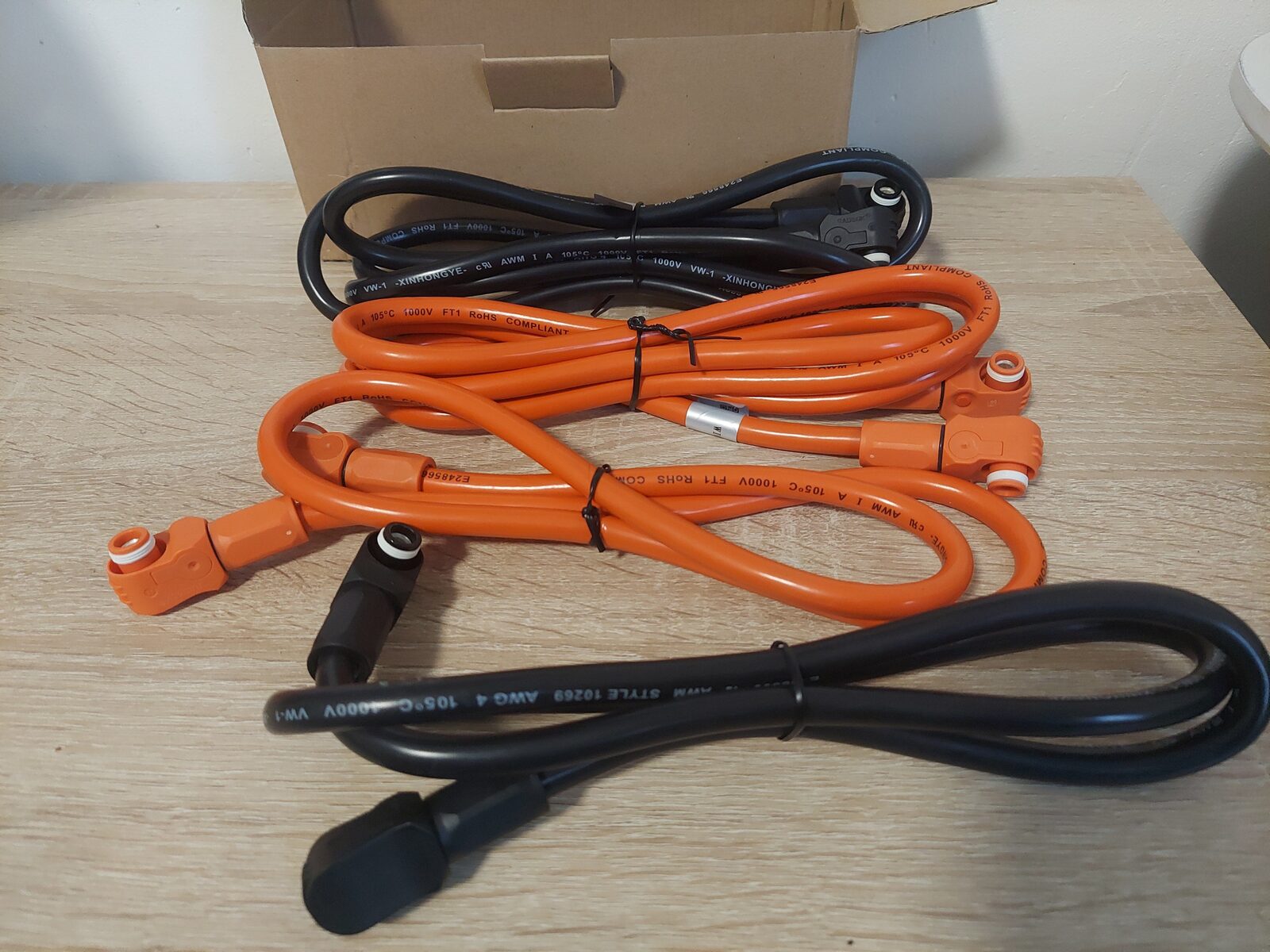
Every length to grow your bank
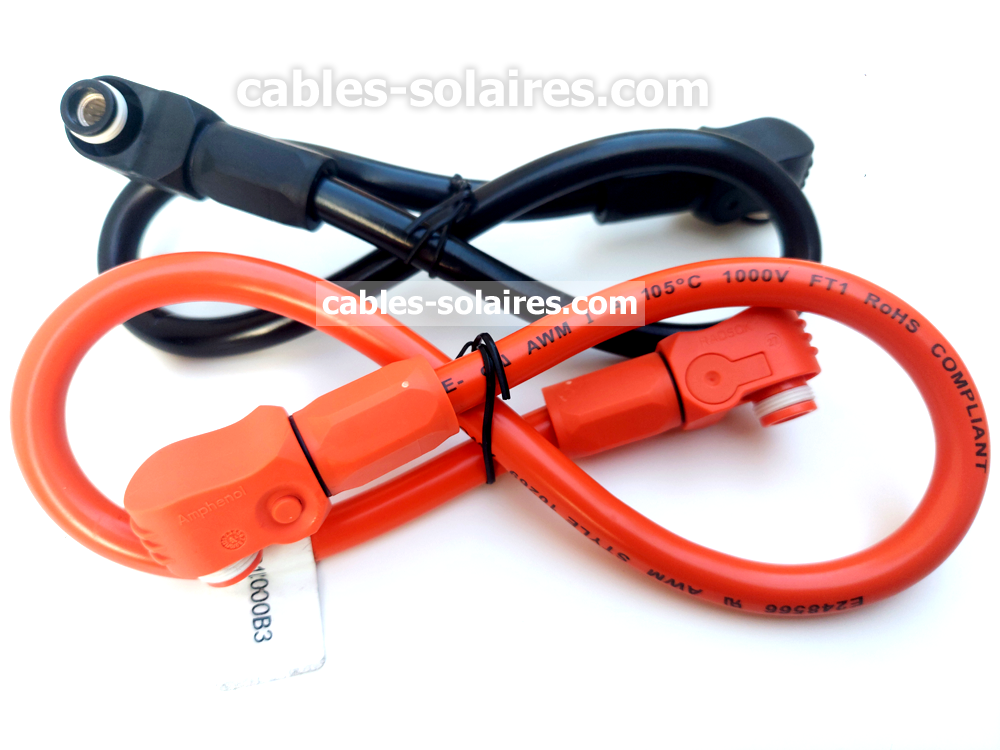
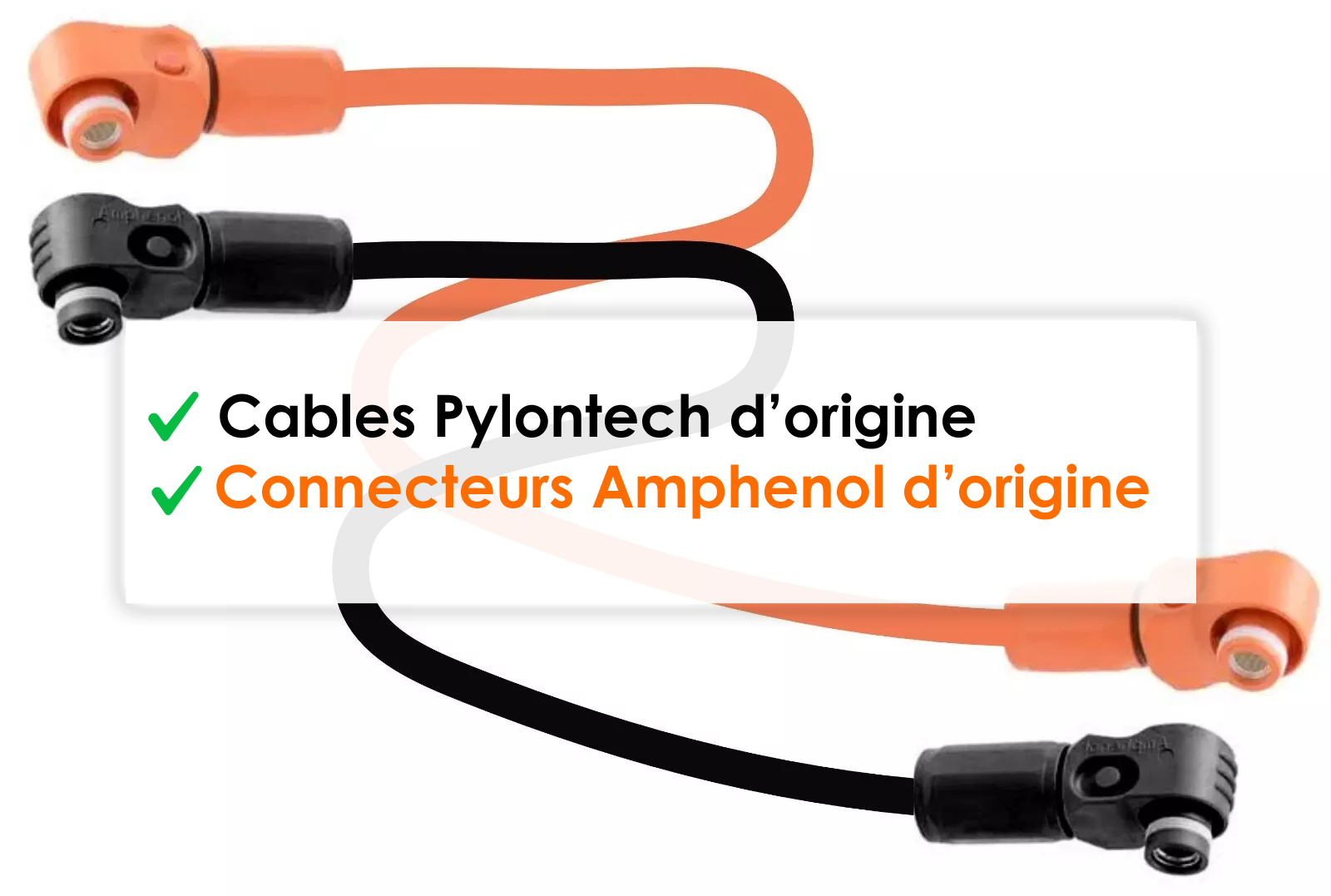
25 mm² section, genuine Amphenol SURLOK Plus connectors, hydraulic crimping, assembled in France. Also sold individually, in orange or black.
Wiring a large bank properly
The bigger the bank, the more the wiring matters. Three simple rules:
- Identical links: all parallel cable pairs in a group must have the same length and section. A shorter link takes more current than the others.
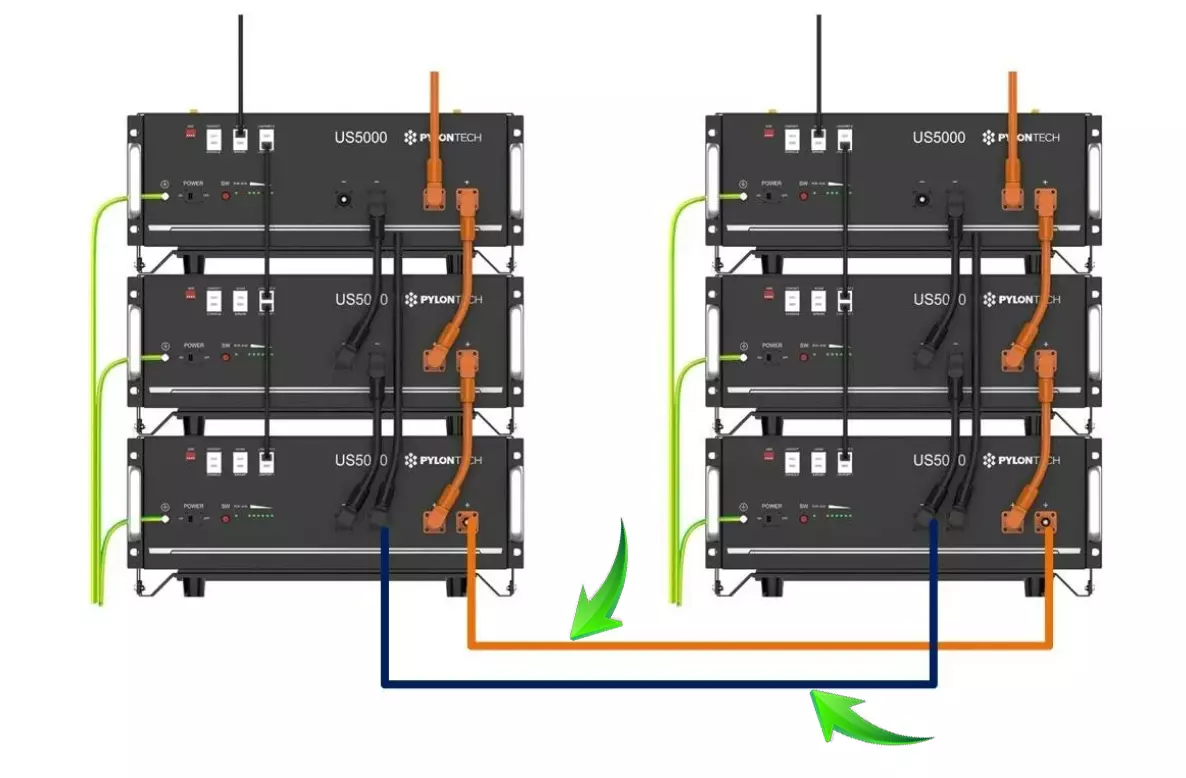
- Cross-connection: take the inverter positive from the first battery and the negative from the last. Each module then sees the same total path, and the current is shared much better, at no extra cost.
- A busbar beyond 5 to 6 modules: each battery connects with its own cable pair (all the same length) to a positive and a negative busbar, and the inverter connects to the bars. It is the best possible current sharing for a large bank. Our Amphenol/M8 cable kit is designed for this type of connection.
The main cables to the inverter
The cables between the bank and the inverter carry the current of all batteries at once. Their section must be calculated for the inverter's maximum current (not for a single battery), with protection (fuse or DC breaker) suited to that section. This is often where an expanded bank becomes undersized: batteries are added, but the original cables sized for one module stay. Our article on cable section (AWG / mm²) gives sizing benchmarks.
Beyond 16 modules: the LV-HUB
When you go beyond 16 modules, or want to split the bank into independent groups (several racks, several rooms), Pylontech offers the LV-HUB. Each group keeps its own master battery and LINK chain; the LV-HUB collects each group's data and is the only device talking to the inverter. The LV-HUB has its own firmware and start-up procedure, to be followed carefully.
On the power side, each group connects to a common busbar, with cables of the same length for each group.
Monitoring a multi-battery bank
The inverter usually shows a single state of charge for the whole bank. It does not tell you that one module runs warmer than the others, that a cell is drifting, or that a slave battery is no longer seen. On a large bank, a monitoring device plugged into the CONSOLE port of the master battery, such as the Pylon-Monitor, shows every module and every cell separately. It is also the easiest way to check that the wiring shares the current properly after an expansion.
Frequently asked questions
How many Pylontech batteries can be connected in parallel?
Up to 16 modules in one group (one master battery, one LINK chain). Beyond that, several groups are connected through an LV-HUB, up to 6 groups.
Can I add a Pylontech battery to a bank that is several years old?
Yes, in most cases, after checking model and BMS firmware compatibility, and bringing the new module and the bank to a similar state of charge before connecting them.
Are the cables supplied with the batteries enough for 4 or 6 modules?
They are enough for tightly stacked modules. As soon as there is a gap, two racks or modules side by side, you need longer cables, the same length for every link.
Do I need one inverter cable per battery?
No. Only one battery, the master, is connected to the inverter. The others communicate with it over the LINK chain.
From how many batteries do I need a busbar?
It is not mandatory, but beyond 5 to 6 modules, a busbar with cables of the same length for each battery shares the current much better than a chain.